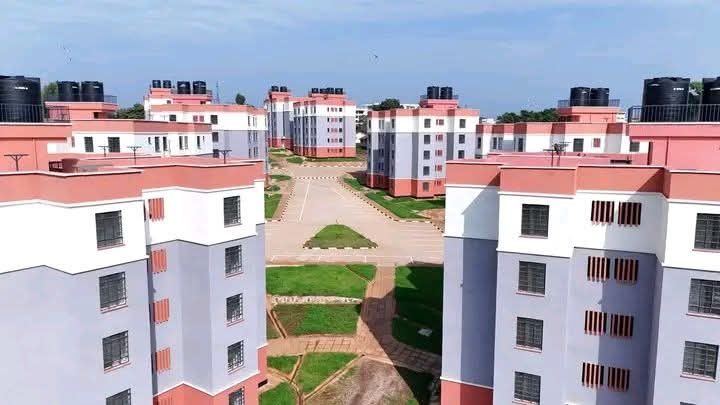
BUNGOMA HOUSING PROJECT THROWN INTO UNCERTAINTY AS COURT ORDERS AIRSTRIP LAND RESTORED
A planned KSh 5.02 billion housing development in Bungoma County has been dealt a major legal setback after the Environment and Land Court ordered the restoration of land earmarked for the project, raising fresh questions about how public land is allocated for major government developments.
The court nullified the proposed Kanduyi Airstrip Smart City Affordable Housing Project, which was expected to deliver 2,034 housing units and supporting amenities on approximately 36.95 acres of land known as Bungoma Township/345. Justice Kossy Bor, in a judgment delivered on October 8, ruled that the project had failed to meet key constitutional and legal requirements governing public land, environmental protection and public participation.
The respondents were ordered to restore the disputed property to its original condition within 45 days, with restoration costs to be borne by the parties held responsible. The court also ordered an environmental planning and land-use audit within the same period.
THE DISPUTE OVER KANDUYI AIRSTRIP
The case centred on whether land reserved for aviation purposes could lawfully be converted into a residential development without following the procedures required by law.
The proposed project was to be constructed on land identified as Bungoma Township/345, measuring about 36.95 acres and associated with Kanduyi Airstrip. The construction contract, valued at approximately KSh 5.02 billion inclusive of VAT, had been awarded to Shyam General Merchants Limited.
The petitioners challenged the government's decision to proceed with the development, arguing that the land's designated use had not been lawfully changed and that the necessary procedures had not been followed.
In its determination, the court found that the respondents had failed to demonstrate compliance with the applicable requirements for converting the public land from aviation use to residential development.
The court consequently declared the project's tender process unconstitutional and void.
WHY PUBLIC PARTICIPATION BECAME A KEY ISSUE
The timing of public consultation was another significant issue in the case.
The court noted that the construction contract had been awarded before a public participation meeting held on January 14, 2026. It found that consultation after key decisions had already been made did not satisfy the requirement for meaningful public participation.
The judgment reinforces the principle that communities must have a genuine opportunity to contribute to decisions affecting public resources before those decisions are finalised.
The court found constitutional violations involving national values and governance, environmental rights, public land and environmental protection, citing Articles 10, 42, 62 and 69 of the Constitution of Kenya.
The decision also highlights the importance of complying with environmental and physical planning requirements before proceeding with large-scale developments.
14 DAYS
The judgment extends beyond the main parcel earmarked for the housing project.
The Kenya Airports Authority and the National Land Commission were directed to establish within 14 days whether six other parcels—Bungoma Municipality/610, 611, 612, 852, 795 and 799—form part of the land reserved for Kanduyi Airstrip.
If the investigations confirm that the parcels belong to the airstrip reserve, the court's declarations and remedies will extend to them, subject to the necessary modifications.
The National Land Commission was also directed to secure, protect and manage the disputed property in accordance with the Constitution and applicable land laws.
Additionally, a permanent injunction bars the respondents from undertaking development, rezoning, leasing, transferring or otherwise dealing with the land in ways inconsistent with its lawful designation.
The petitioners were awarded the costs of the proceedings.
EFFECT RULING HAS TO AFFORDABLE HOUSING
The immediate consequence is that the proposed Kanduyi development cannot proceed on the basis of the invalidated tender process. The restoration order and restrictions imposed by the court also place the future of the project in doubt.
However, the decision concerns the legality of this particular development and the use of the disputed land. It does not amount to a blanket cancellation of Kenya's national Affordable Housing Programme.
For Bungoma residents, the case raises important questions about the management of public land, the protection of designated public facilities and the role of public participation in government planning.
It also demonstrates that projects intended to address housing needs must comply with constitutional safeguards and land-use laws before implementation.
The next steps will depend on compliance with the court's orders, the required investigations into the additional parcels and any further lawful decisions concerning the land.